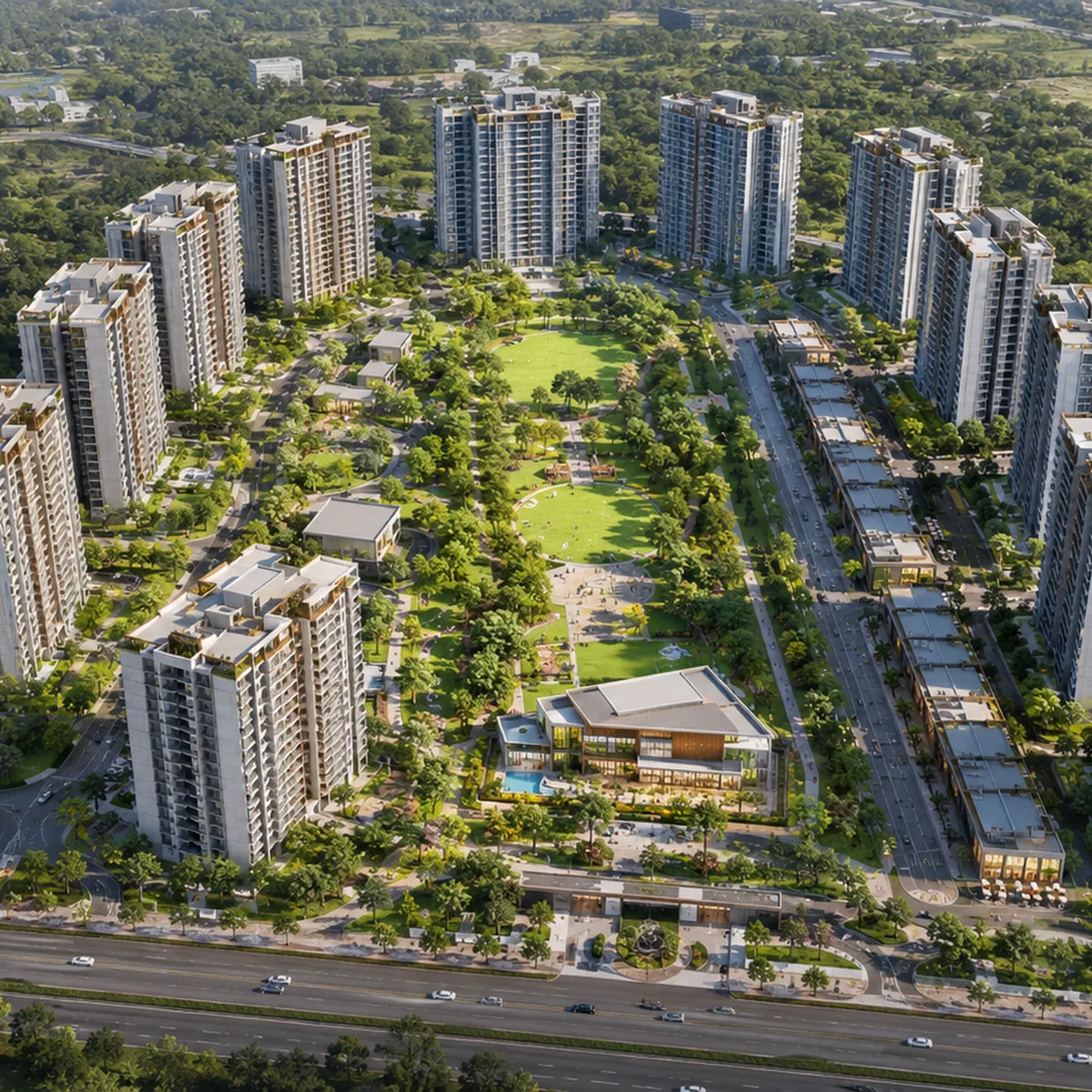
What Is Established About the Land
| Element | Position as at 16 September 2026 |
|---|---|
| Land extent | 20.19 acres, and this is the whole site |
| Acquisition | Outright purchase completed at ₹588.33 crore, announced 21 July 2025 |
| Definitive agreement | 3 January 2025, for the same land |
| Land held by | Ananthay Properties Private Limited, a subsidiary of Brigade Enterprises Limited |
| Intended uses | Residential, commercial and retail |
| Development potential | About 4.2 million sq ft |
| Gross development value | About ₹5,200 crore |
| Sanctioned building plan | Not on the public record |
| Towers, floors, homes, open ground, clubhouse | Not established |
| K-RERA registration | None, and no pending application |
The land was bought outright and in one piece. It is the whole of what the developer bought on this corridor, no further land has been attached to it, and no sequencing statement has been made about it. Read the 20.19 acres as the site.
Potential Is Not Committed Area
Both floor-area figures attached to this land are statements of what it could carry, not of what will be built.
| How the scheme was described | Stated potential | Gross development value |
|---|---|---|
| January 2025, residential | About 2.5 million sq ft | About ₹2,700 crore |
| July 2025, residential, commercial and retail | About 4.2 million sq ft | About ₹5,200 crore |
Those are two descriptions of one parcel six months apart, not two parcels. What changed is the scheme, not the land. That is worth holding on to, because it shows how far this can still move: a scheme that grew by two-thirds on paper in half a year can be sanctioned smaller, sanctioned in a different mix, or sequenced differently. The only floor area that will ever bind anyone is the one on a sanctioned plan and in a registration.
What 4.2 Million Sq Ft on 20.19 Acres Implies
20.19 acres is about 8.8 lakh sq ft of land. Set the stated potential against it and the intensity is easy to read.
| Scheme as described | Stated potential | Ratio to land area |
|---|---|---|
| January 2025, residential | About 2.5 million sq ft | About 2.8 times |
| July 2025, mixed use | About 4.2 million sq ft | About 4.8 times |
Both ratios are ordinary for well-located Bengaluru land, and the higher one is the honest headline: about four and a half to five times the site area in floor space is an intensive scheme, and intensity of that order is not delivered by low-rise building. That is as far as the arithmetic goes, and this page goes no further with it. It does not establish a tower count, a storey count, a home count or how much of the ground stays open, and no number of that kind appears on this site, because none exists.
One more consequence follows from the mix. Because the 4.2 million sq ft spans homes, offices and shops, the residential share of it is smaller than the headline, and the split has not been stated. A buyer being quoted the full figure as the size of the residential community is being quoted the wrong number.
What Mixed Use Changes for a Home Buyer
A mixed-use scheme of this size is not a housing project with a few shops. It sets up questions that a purely residential layout does not, and they are worth asking early because the answers are fixed in the plan long before they are fixed in your agreement.
- Which parts of the land are residential and which are commercial or retail, and where the boundary between them runs.
- Whether the commercial component has its own access and parking, or shares yours.
- How long the commercial construction continues after the homes are handed over, and who lives alongside it while it does.
- Which amenities belong to the residents and which are shared with office and retail users.
- What the commercial component contributes to, or takes from, your maintenance charge.
What To Ask To See Before You Commit
When the scheme reaches launch, ask for these and read them yourself rather than accepting a summary.
- The sanctioned building plan, with its approval reference and date.
- The K-RERA registration, and the land extent, promoter name and plan particulars recorded in it.
- The registered land extent and survey numbers, checked against the plan.
- The tower and unit schedule, and the open against covered ground on the sanctioned plan.
- Parking provision and where it sits.
- A statement in writing of whether the land will be built out in stages, and if so what is built in each stage and when.
- The name of the entity you are contracting with. A registration for this land would be expected in the name of the subsidiary that owns it rather than the listed parent, and a buyer searching the register under the parent's name may not find it.
Registration Status as at 16 September 2026
There is no K-RERA project registration for this land and no pending application, as at 16 September 2026. Under the Karnataka rules the project cannot be advertised or sold until registration is granted, so no booking, allotment or payment should be accepted against it. Brigade's managing director told analysts on the 14 August 2026 earnings call that the launch had been advanced to the October-December 2026 quarter, so the position may change within weeks. Verify it yourself on the Karnataka RERA register at rera.karnataka.gov.in.
If a registration string is shown to you for this project and it contains /AG/, it is not a project registration. That class of number is an agent registration, held by an individual or a brokerage as a licence to sell. One such agent number, belonging to a brokerage and unconnected with Brigade, with this land or with the company that owns it, circulates online as though it were this project's registration. It registers nothing about this land, and it is not evidence that any approval exists. A Karnataka project registration is a different class of number entirely, and the register is the place to confirm it.
For the location and what is known about the address, see the location page; for what to check on a layout when one is published, see the floor plans page.
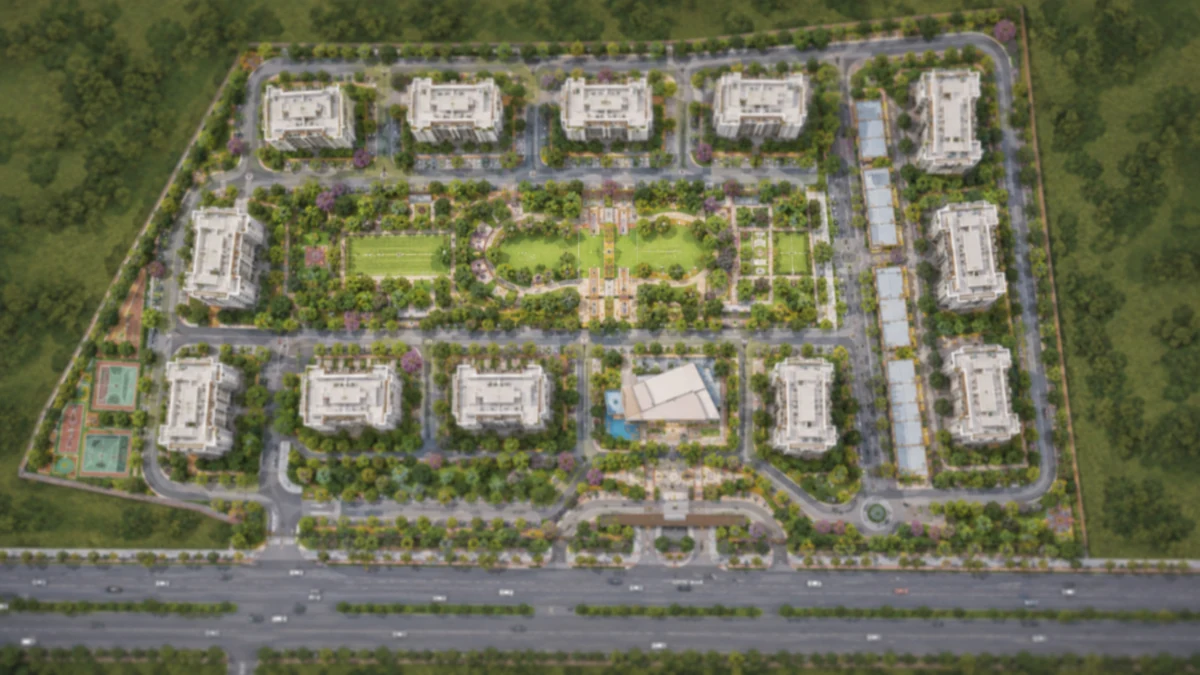
Brigade Granada master plan
Brigade Granada FAQs
What are the floor plans and configurations at Brigade Granada?
None has been published. There are no released floor plans, no confirmed apartment types and no stated sizes for this project, so nothing of that kind appears on this site.
Is Brigade Granada a residential project only?
No. The scheme as described is mixed use, with residential, commercial and retail components on the same site. An earlier description of the land in January 2025 was residential only, at about 2.5 million sq ft and a gross development value of about ₹2,700 crore.
What is the gross development value of Brigade Granada?
About ₹5,200 crore for the mixed-use scheme, as described by Brigade in July 2025. Gross development value is an estimate of what the completed development could realise over its life. It is a developer's planning figure, not a price to a buyer.
Why did the scale of the Brigade Granada scheme change during 2025?
The land did not change; the plan for it did. In January 2025 the parcel was described as a residential scheme of about 2.5 million sq ft with a gross development value of about ₹2,700 crore. By July 2025, when the purchase completed, it was described as a mixed-use scheme of about 4.2 million sq ft with a gross development value of about ₹5,200 crore on the same 20.19 acres.
When is possession at Brigade Granada?
There is no completion or handover date. A completion date becomes a binding commitment when it is recorded on a RERA registration, and no registration exists for this project as at 16 September 2026. Any handover year quoted to you today is an estimate with nothing behind it.
Ask before you commit
Ask which registered project you are actually being offered, and check the register yourself at rera.karnataka.gov.in before you part with any money.